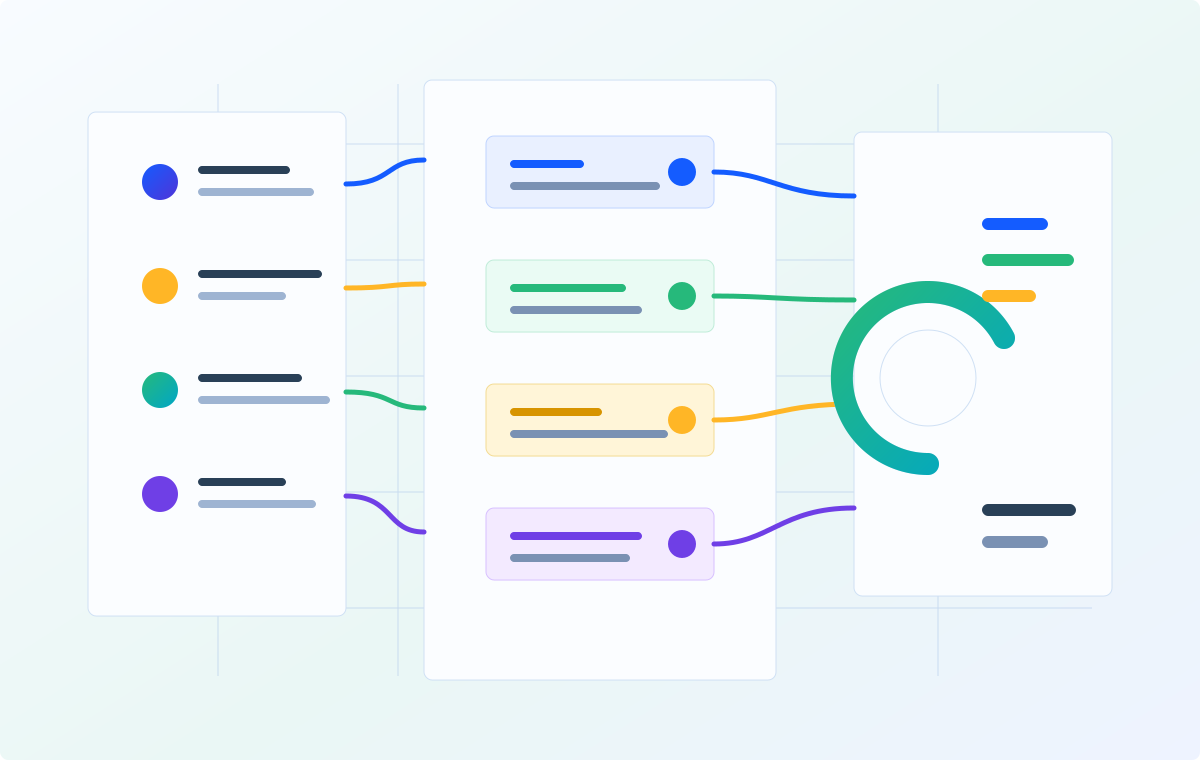
Redesign workflows
High performers are far more likely to redesign individual workflows and scale agents with leadership ownership.
McKinsey State of AI 2025
AI adoption assessment for operational teams
Stop buying AI. Start executing on your knowledge. The assessment shows whether your next move should be Adopt, Adapt, or Build.

European innovation backing supports Blinkin's work on trustworthy, sovereign AI workflows for real operational environments, not generic AI experiments.




Start with the assessment. It looks at workflow pain, knowledge readiness, governance, and adoption muscle, then routes you to Adopt, Adapt, or Build.
Answer eight questions. The assessment estimates readiness, operational urgency, governance clarity, and whether your next move is Adopt, Adapt, or Build.
The assessment helps choose the right entry point. Start with a proven pattern, tailor it to your work, or build your own agentic system when the organization is ready.
Start fast with a clear pain point, a proven companion, or a reusable template. Build confidence with a low-friction first use.
Let domain experts adjust knowledge, workflows, prompts, forms, and outputs so the AI fits the way real work happens.
Design and scale your own agentic apps across systems, with governance, integrations, and human control built in.
Blinkin is relevant when critical knowledge is decaying, operational execution is still manual, and teams need AI inside the work, not beside it in a chat box.
Senior experts carry know-how that is not captured in executable workflows.
Field teams still collect images, videos, forms, checklists, and voice notes manually.
Quality, onboarding, support, and compliance vary by site, country, or team.
AI adoption needs sovereignty, role-based literacy, auditability, and measurable value.
The useful pattern is consistent: pick the workflow, connect the knowledge, govern the use, prove the result, then decide whether to adopt, adapt, or build.
High performers are far more likely to redesign individual workflows and scale agents with leadership ownership.
McKinsey State of AI 2025Impact requires leadership alignment, systems integration, workflow redesign, and change management.
OpenAI Frontier AlliancesHigh-outcome organizations integrate AI strategy across business units and measure benefits regularly.
Gartner AI practicesResponsible AI needs inventory, governance, risk-based review, controls, monitoring, and change management.
BCG Responsible AIEU-specific trigger: Article 4 AI literacy obligations already apply, with national supervision and enforcement rules due from August 2026. European Commission Q&A
Start here
Your result turns Blinkin into a practical next step: adopt a proven pattern, adapt it to a real workflow, or build a governed agentic system when the case is strong enough.
Start the assessment